

Currently Empty: $0.00




ESG is an acronym that has become quite familiar. It started as a buzzword among investors seeking companies with ethical and responsible business practices. Right now, ESG is more than a buzzword. The heightened concerns about the impacts of climate change, stakeholder interests, and expectations, relating to ESG has increased dramatically over the past few years.
Interested ESG stakeholder groups have expanded well beyond mainstream investors and environmentalists to encompass customers, employees, regulators, lawmakers, suppliers and others. Environmental, Social, and Governance (ESG) expertise has become a game-changer in the boardroom.
Beyond profit margins and shareholder returns, there is a growing recognition that companies must also be responsible stewards of our planet, communities, and ethics. In today’s fast-paced and interconnected business world, the landscape of corporate governance is undergoing a remarkable shift. The bridge between the traditional corporate governance and this evolving paradigm is Environmental, Social, and Governance (ESG) expertise.
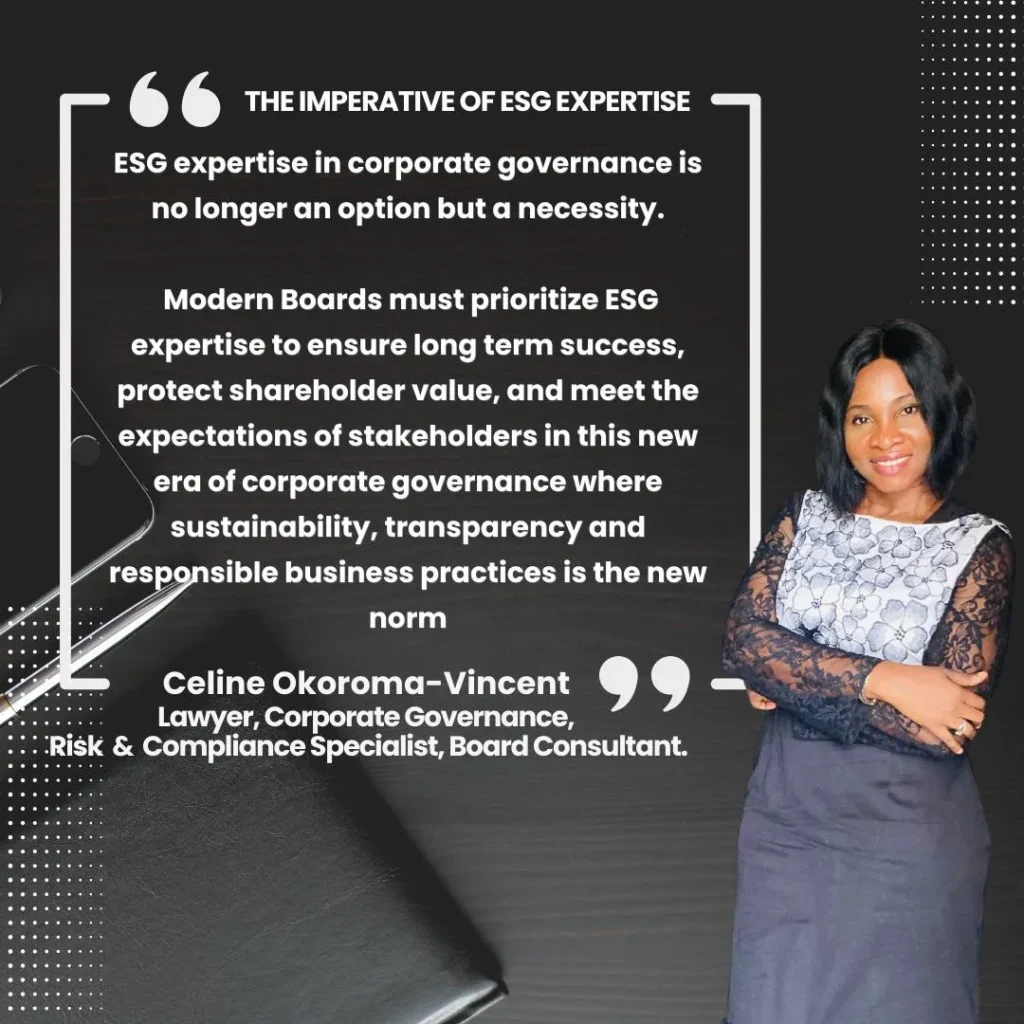
ESG has become a strategic imperative for boards aiming to future-proof their organizations. Hence, embracing ESG expertise not only drives positive change but also positions companies for long-term success in a world where sustainability, transparency, and responsible business practices are the new norms.
So, why is ESG expertise crucial for modern boards? Let us explore a few points:
1) It enhances risk management and reputation: ESG expertise equips boards to identify and mitigate potential risks. By understanding the environmental, social, and governance factors affecting their industry, companies can preemptively address issues that might otherwise lead to reputational damage or financial setbacks.
2) It fosters innovation and resilience: Sustainability is not just about being green; it is about innovation. ESG-focused boards encourage creativity and the development of sustainable products, services, and processes. This innovation can open new revenue streams and reduce operational costs. Case in point is the Nike Flightknit Technology footwear range.
3) It aligns business goals with societal and environmental impact: ESG principles align business goals with societal and environmental impact. When these factors are integrated into a company’s strategic decision-making, it fosters a sense of purpose and social responsibility among employees and stakeholders, creating a positive feedback loop for all stakeholders.
Understanding the Stakes associated with ESG Risks
To appreciate the significance of ESG expertise, we must first acknowledge the evolving risk landscape associated with Climate change, social unrest, ethical lapses, and governance failures. These are no longer abstract concerns but tangible threats to businesses.
Financial Implications of Climate Risk:
According to the World Economic Forum, climate-related risks account for five of the top ten risks by likelihood and impact in 2021.
A report by McKinsey estimates that climate-related physical risks could result in annual losses of $360 billion for businesses in the United States alone by 2030.
Social and Governance Risks:
The Edelman Trust Barometer reveals that 67% of global respondents believe CEOs should hold themselves personally accountable for addressing societal issues.
Governance failures, such as data breaches and ethical misconduct, have led to substantial financial penalties, reputational damage, and legal consequences for numerous companies globally.
This is how ESG expertise can help modern boards:
Identify Risks Proactively: ESG-savvy boards are better equipped to identify emerging risks. For instance, they can assess the impact of climate change on supply chains and operations, allowing for strategic adjustments before crises strike.
Enhance Reputation and Stakeholder Trust: A study by EY suggests that companies with strong ESG performance tend to recover faster from reputation-damaging events. Forbes reports that companies demonstrating ESG commitment enjoy higher customer loyalty, trust, and employee engagement.
Improve Financial Performance: Data from the Harvard Business Review reveals that companies with strong ESG performance often outperform their peers financially. The MSCI World ESG Leaders Index, comprising companies with high ESG ratings, consistently outperformed the MSCI World Index from its inception in 2007 to 2020.
Product and Service Development: ESG-savvy boards can guide innovation toward sustainable product and service development. This not only aligns with market demand but also positions the company as a leader in responsible business practices.
Examples of organizations putting ESG Expertise in Action
Nike footwear
Nike, with its focus on sustainable sourcing and ethical labor practices, mitigated supply chain risks during the COVID-19 pandemic more effectively than many competitors did. Nike maintained Supply chain resilience because of its renewable materials sources and did not suffer supply chain disruptions during the pandemic.
Apple
Apple’s commitment to renewable energy not only aligns with ESG principles but also insulates the company from energy price fluctuations and regulatory changes. Apple’s commitment to renewable energy usage sets it on the path of Climate Risk preparedness and meeting global climate action goals.
Conclusion — A New Imperative for Corporate Boards
ESG expertise within corporate boards is not just a trend; it is a necessity. The data paints a compelling picture.
The data and metrics do not lie — ESG expertise is no longer a peripheral concern for corporate boards; it is a strategic imperative. Boards equipped with ESG acumen are better positioned to navigate the ever-evolving risk landscape, protect their organizations’ reputation, and drive long-term financial performance.
In an era where the consequences of overlooking ESG risks can be devastating, boards must recognize the value of ESG expertise as a risk management tool that goes beyond compliance — it is a path to sustainable success.
Modern Boards must believe in the transformative power of ESG and be committed to integrating ESG principles into their strategic decisions, from supply chain sustainability to responsible governance practices. This commitment is not only an ethical duty but also a driver of long-term profitability and growth.
Let us not view ESG as a mere checkbox but as a compass guiding us toward a brighter and more sustainable future. Together, we can demonstrate that ethical and responsible business practices are not just good for the world; they are good for the bottom line too.
About the Author: Mrs. Celine Okoroma-Vincent is a Lawyer, Corporate Governance and Compliance Professional. She is a Certified Management Consultant and a Fellow of the Institute of Management Consulting-Nigeria.